

LA STAGE WATCH is a series of articles by staff writer/blogger Don Shirley.
Too many producers of new musicals distrust new music. They’re convinced that their target audiences won’t buy tickets without the assurance of already familiar tunes. And God forbid that a theatergoer might exit without humming the melodies - even though just about any melody requires some repetition before most people remember it.
Witness the two commercially-oriented musicals that opened over the weekend. They don’t look as if they would have much in common, but both Baby, It’s You! (at Pasadena Playhouse) and Mary Poppins (at the Ahmanson Theatre) try to appeal to the 50-70-year-olds with the promise that at least they’ll hear a few well-worn songs from their youth.
Baby It’s You! might better be titled Baby Boomer, It’s You! Unfurling golden oldies galore, it’s aimed squarely at people who were coming of age in the late ’50s and the ’60s. The hit parade almost obliterates the show’s purported story about Florence Greenberg, the New Jersey ex-housewife who turned the Shirelles into stars.
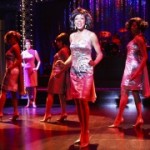
Meeghan Holaway, back, as Florence, and Berlando Drake, front, as Shirley of the Shirelles
Early on, it appears that some of those old hits will be used in the style of book musicals - to expand the dialogue when more intense emotions need to be expressed. Florence and her hubby have an argument that turns into song. But then this technique is almost completely forgotten in favor of a more presentational format. Especially in the second half, segments of the show feel like a revue, a la Beehive or Smokey Joe’s Café, instead of a book musical.
An actual playwright might come in handy. The script is by the director Floyd Mutrux and Colin Escott, whose credits are dominated by documentaries.
They ignored many of the obvious opportunities to deepen the drama. Although she is a gender-smashing pioneer, Florence encounters hardly any sexism as she glides - remarkably effortlessly - up the ladder of the music industry. The individual Shirelles remain almost completely anonymous.
Near the end, the scenario skips from the moment when Florence decides that the Shirelles are all washed up to the moment when she joins them on stage for a warm and impromptu reunion several years later. We don’t see the moment when she (or whoever) informs them that she no longer requires their services.
Apparently Mutrux and Escott lacked the stage time necessary to strengthen the story - because a long list of additional songs had to be crammed into the show. I couldn’t help but compare the dramatic deficiencies here to the narrative power of Dreamgirls, which should be a template for any musical about girl groups. Of course, Dreamgirls came with an original score, so the music could be better integrated with the drama. Somehow, it managed to become a hit, even though its first audiences hadn’t yet heard the music. (In fact, a revival is coming to the Ahmanson in February.)
By the way, Baby It’s You! ends a 2009 season at the playhouse that began with another biographical musical that was also about a music legend, Lena Horne. Two years ago, we saw a generic Ray Charles bio-musical in the same space. Is it just me, or are others welcoming the news that the 2010 season appears to be free of any musicals about pop stars? Thank you, Sheldon Epps.
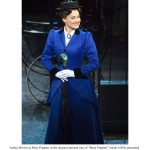
Ashley Brown as Mary Poppins
The target audience for Mary Poppins is more specific than boomers in general. It focuses on anyone who was a child in 1964, when the movie was released. Of course, the producers hope that the movie’s first audience will now bring along freshly minted children - either their own kids, if the boomers delayed child-bearing until their 40s, or if not, their nephews, nieces or, gulp, grandchildren.
Producer Cameron Mackintosh at least commissioned some new music for Mary Poppins to supplement the existing Sherman Brothers hits. George Stiles and Anthony Drewe successfully integrated their new score and the Sherman sounds.
The show is less successful at integrating the songs into the new Julian Fellowes script. During the biggest Matthew Bourne-created dance number, “Step in Time,” I kept wondering how cheerful chimney sweeps enhance the story - or whether today’s kids can even grasp the notion of a chimney sweep, especially as the dancers hardly ever seem to sweep chimneys. I guess we’re simply supposed to admire Gavin Lee’s sideways and upside-down stroll around the proscenium without giving much thought to the characters. Likewise, we’re supposed to ooh and aah over Mary’s final ascent into the heavens without asking many questions.
In other words, just as Baby It’s You! uses pop nostalgia to dilute the story about a woman from a different world who turns around the lives of considerably younger people, this new Mary Poppins uses stunts and scenic effects to achieve a surprisingly similar goal.
Baby It’s You! continues at the Pasadena Playhouse, 39 S. El Molino Ave., Pasadena. Tues.-Fri., 8 p.m.; Sat. 4 and 8 p.m.; Sun. 2 and 7 p.m.; through Dec. 13. Tickets at PasadenaPlayhouse.org or at 626-356-7529.
Mary Poppins continues at the Ahmanson Theatre, 135 N. Grand Ave., Los Angeles. Tues.-Fri., 8 p.m.; Sat. 2 and 8 p.m.; Sun. 1 and 6:30 p.m.; Wed., 2 p.m. on Nov. 25 and Dec. 23; Thur., Feb. 4, 2 p.m.; through the matinee on Feb. 7. Dark on Nov. 26, Dec. 9 and 25, and Jan. 1. Tickets at CenterTheatreGroup.org or at 213-972-4400.
I was puzzled a few weeks ago by something in Parade, the much more original musical that just closed, next door to Mary Poppins. Six actors, including three who are quite familiar to L.A. musical theater audiences (Will Collyer, Karole Foreman and Robert Yacko) were listed as “ensemble” as well as “understudies” - but I couldn’t spot them onstage. I wondered why these “ensemble” members weren’t appearing, even as nine other actors played more than one role apiece.
It turns out that the six were singing backstage, at least when they weren’t going on as understudies for flu-stricken actors. If they had been performing minor roles regularly, they might not have been available to have performed their understudy duties - without having understudies of their own.
Now, I realize that the size of this Parade was pared from the original Broadway production. At least part of the reason for this surely was to make it more economically feasible. I don’t know how much everyone was paid or how difficult the logistics would have been to have used some of the six actors in minor onstage roles. But to these eyes, the use of some actors in as many as three roles apiece was potentially confusing, and it seemed especially strange because so many “ensemble” members appeared to be missing.
Baby It’s You! photo by Michael Lamont.
Mary Poppins photo by Joan Marcus.